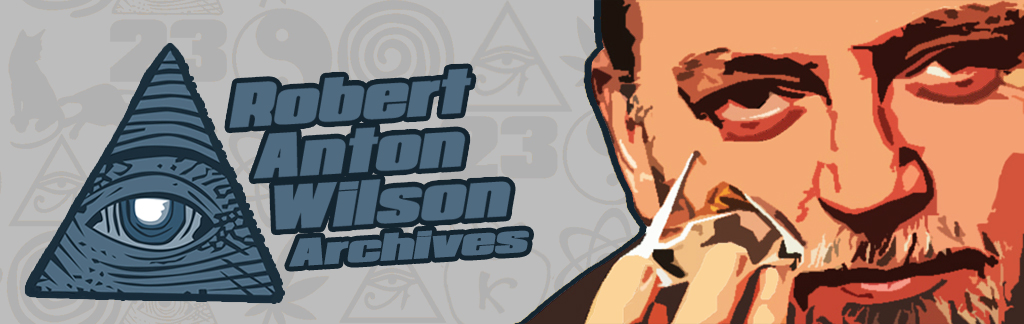
Can it be that this man in the polyester leisure suit with a powder blue shirt and matching socks, with combed-back hair and goatee, can it be that this man is a mystic?
Maybe. But Robert Anton Wilson wouldn’t admit it. He would admit to being a Pagan, an initiated Witch. He might admit to being a futurist and a visionary. A philosopher. But a mystic? Never.
Wilson is, however, an accomplished writer, author of fourteen books including the Illuminati series. He is popular with the altered states crowd and the space opera groupies. They are here to listen to their guru.
He speaks at a science fiction convention at a seedy former disco in Eugene, Oregon. The lighting is bad. The microphone squeals as Wilson tells the small audience about paths to higher consciousness.
He speaks of Sufi meditations and space exploration in the same context. In the same sentence.
But he has no wish to be a guru. On the contrary, he hopes his writings make people more skeptical. He’d like his readers to look at themselves and others with more humor and more optimism. He tells me he wants to dispose of despair as a mechanical reaction, something he feels is common—almost chic—these days.
“There’s such a thing as self-fulfilling prophecy,” he says. “If despair gets widespread enough everybody assumes everything is hopeless and things will become hopeless. But, if we can jar people out of that, we’ll find our potentials as great as our dangers.”
With this attitude and a background in Paganism, Wilson helped found the Discordian movement whose followers “worship” Eris, the Goddess of discord and confusion.
Members often describe the movement as “a new religion disguised as a complicated joke.” Wilson calls it “a Marx Brothers’ version of Zen.”
Discordian themes appear in his books; they show up in his speeches; they are a part of his philosophy. His style is half serious, half tongue-in-cheek. Wilson calls being able to tell the difference “an intelligence test.”
He speaks to a group of his readers, his fans. He tells them about metaprogramming, John Lilly’s theory of change of consciousness. He encourages personal and scientific research of altered states.
He talks at length about the genetic code and its relationship to metaprogramming.
The speech wanders a bit but the audience never wavers. He relates a fable about a Sufi sage and his invisible donkey. He mentions “Our Lady of Guadalupe.”
“Space and time are completely unreal. What we observe is only a creation of our own nervous system, not an intrinsic property of the universe,” he reveals. Hail Eris. Hail Discordia.
Someone asks if he takes all of these ideas seriously. “I take them seriously on Mondays, Wednesdays, and Fridays. I take them as a joke on Tuesdays and Thursdays. On Sunday, I’m an agnostic,” says the Discordian. He smiles.
Wilson thinks of himself as a happy man. “You’re as happy as you decide to be. It’s a device to protect the gene pool. The happier people are, the further they spread happiness. Now we’ve got the potential to consider the whole country, world and ecosphere.”
Back home in San Francisco another novel, The Naked Goddess, is waiting to be finished. Wilson didn’t sell his first novel until he was forty.
He says he learned to write while spending five years as a magazine editor and while writing copy for mail order catalogues. “It got easier and easier to write books,” he tells me.
Robert Anton Wilson. He scrawls his name in one of his books for a waiting young man. He tries to tell me about the importance of the life-extending drugs he believes will soon be available but other devotees of the mystic are waiting with their books for his signature.
“I don’t want to live forever,” he says. “Only as long as I find life exciting.” For Robert Anton Wilson, that should be a long, long time.


An Interview with Robert Anton Wilson
by Stephanie Fox appeared in Circle Network, Volume 4, Issue 1 in Spring 1982.